Every brand with soul tells a story
A product can be copied. A price can be matched. But a story, told with enough clarity and conviction, becomes nearly impossible to replicate. At BBMB, we have built our entire intake process around this truth: before we look at what a client sells, we look at where they come from. It is not always a comfortable starting point — but it is always the right one.
There is a particular moment that happens in almost every early client conversation at BBMB. We have been introduced, the brief has been shared, and then we turn the conversation away from the product entirely. We ask about the founder. About the decision that started everything. About what was at stake and what they believed when no one else did yet. The reaction is often the same: a pause, a slight recalibration, sometimes a quiet concern that we have misunderstood the assignment. We have not.
The product is not the story
It is a natural instinct to lead with what you make. The product is tangible, measurable, easy to explain in a pitch deck. But a product is also, by definition, replaceable. A better version can arrive next season. A competitor can study your specifications and close the gap within a year.
What cannot be copied is origin. The specific sequence of circumstances, beliefs and decisions that brought a brand into existence belongs entirely to that brand. It is not a marketing angle. It is infrastructure. And when it is built into the brand properly, it does everything the product cannot do alone: it creates meaning, it earns loyalty, and it makes price feel secondary.
This is why we always begin with the personal story of the person or people behind the brand. Not as a warmup exercise before the real work — but as the real work itself.
What legacy brands already know
The clearest evidence for this approach is not found in start-up success stories. It is found in the brands that have endured across decades — particularly in the luxury segment, where longevity is not incidental but structural.
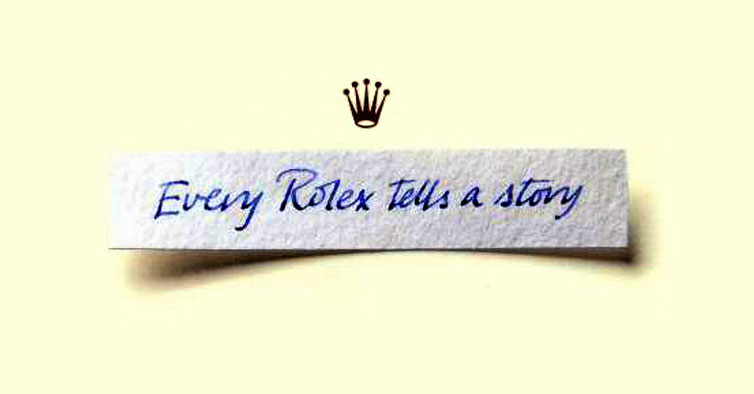
Consider Rolex. In their campaign "Every Rolex Tells a Story", the watch is reframed entirely. It is no longer an instrument for measuring time. It becomes a marker of something achieved, something passed down, something that outlasts the moment of acquisition. The campaign works not because of what Rolex made, but because of what ownership means within the world Rolex has constructed over generations.
That world did not appear in a campaign. It was built through decades of consistent positioning — every choice reinforcing a single, coherent idea about what the brand stands for. The campaign simply made that meaning legible.
Conviction before visibility
A common mistake at the early stage of brand-building is to invest in visibility before investing in clarity. A well-produced campaign without a grounded story behind it is expensive noise. It may generate attention, but attention without meaning does not convert into the kind of trust that makes a brand last.
When clients come to us uncertain about why we focus on their background rather than their offering, we show them this pattern. The brands with the longest shelf lives are not the ones that spent the most on production. They are the ones that knew — with total conviction — what they believed and why they existed. Everything else followed from that.
Hermès did not become Hermès by describing their leather goods. They built a world defined by craft, restraint and a specific idea of excellence that preceded any individual product. The product became proof of the story, not the other way around.
Something that lives longer than the trend
There is a phrase we return to often internally: we are not building for this moment. A brand built around a trend has to keep chasing. A brand built around a story has something to return to — a source it can draw from year after year without depleting it.
This is the principle behind how we approach every new client relationship. We take time at the beginning that might feel slow, asking questions that seem far from the brief, because that time shapes everything downstream. The tone of voice, the visual direction, the way the brand enters a room — all of it is more coherent, and more durable, when it is anchored to something true.
The brands we most admire are not the ones that were loudest. They are the ones that knew exactly what they were saying, and said it with such quiet consistency that the world eventually came to believe it too. That is what a story, properly told, can do for a brand. And it is where we always begin.