Concept branding in 3D
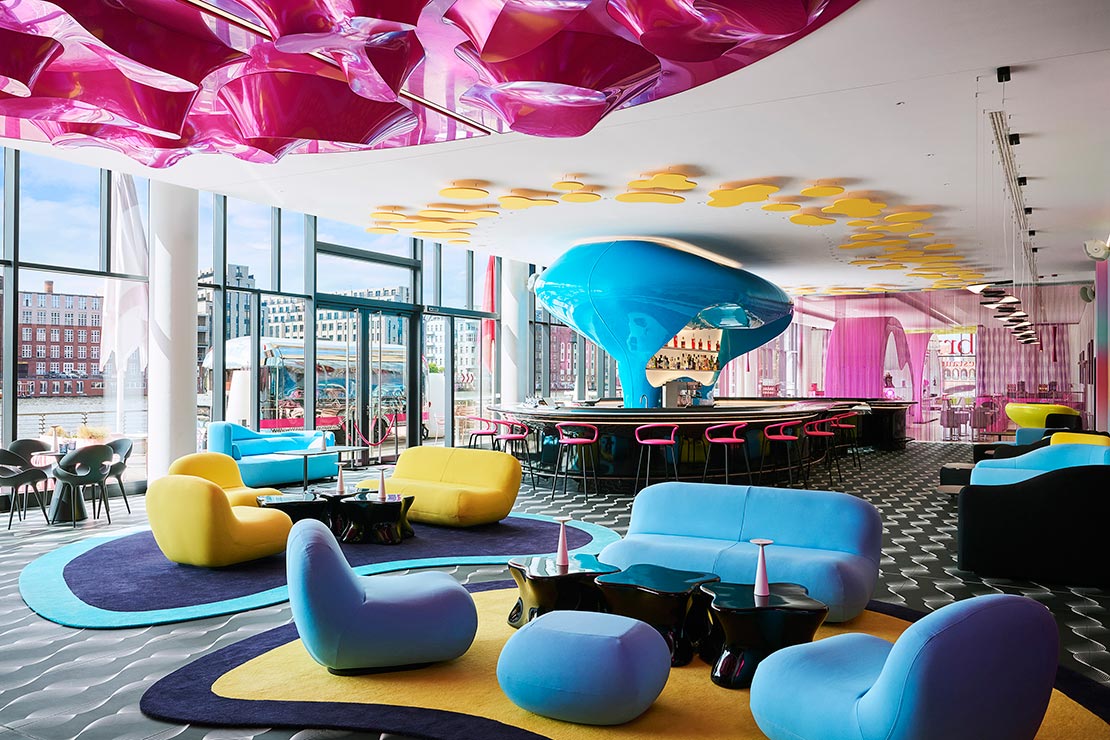
Some brands are not experienced through a logo. They are experienced through a room, a scent, a quality of light. When every element of an encounter tells the same story, the brand stops being communication and starts being reality.
When the logo is the least interesting thing in the room
Most brand conversations begin and end with the visual identity: the mark, the palette, the typeface. These things matter. But they are the surface expression of something that either exists underneath them or does not. When a brand is reduced to its logo, the logo has to carry more weight than any symbol can hold. It becomes a label on a box rather than a door into a world.
Concept branding begins with a different question. Not "how should this look?" but "what should it feel like to be inside it?" The distinction sounds philosophical until you walk into a space where the answer has been worked out completely, and you feel it before you have read a single word. The temperature of the light. The register of the staff's voice. The weight of the menu in your hand. Each of these is a brand decision, whether or not anyone made it consciously.
What most people think of as branding is communication. Concept branding is environment. It is identity expressed in three dimensions, and it works on a guest, a customer, a visitor in a way that communication alone cannot, because experience bypasses scepticism. You can disbelieve a headline. You cannot disbelieve what you are standing inside.
What concept branding actually requires
The temptation, once the idea takes hold, is to think in terms of mood boards: gather images, agree on a feeling, brief the interior designer. That is where the process usually goes wrong, because a mood board captures aesthetics and not architecture. Concept branding is not about how things look in a photograph. It is about how they hold together when a real person moves through them in real time.
The work begins with a decision that is more editorial than creative: what is this brand's single organising idea? Not its values, not its positioning statement, not its promise to the market — though all of those feed in. The organising idea is the thing every subsequent decision can be tested against. If you cannot hold it in one sentence, it is not yet an idea. It is a collection of preferences.
Once the organising idea is clear, it has to be translated into a set of principles that govern every discipline involved in building the brand's world. This is where concept branding gets demanding. It is not enough to agree that the brand should feel "warm and considered." Warmth has to be specified: what temperature of light, what ratio of soft to hard surfaces, what does the staff training say about pace and eye contact. Considered has to mean something in the music selection, in the way menus are written, in how long a guest is allowed to sit before anyone approaches. Every principle has to cash out into a decision that a real person in a real operational context can actually make.
The sequence matters enormously. Begin with the spatial and sensory before you touch the graphic. The physical experience is what guests will live in; the visual identity is what they will remember when they are gone. If you design the logo before you understand the room, the logo will either contradict the room or be irrelevant to it. Work from the inside out.
The Berlin project, and what it proved
A few years ago, BBMB worked with a hotel in Berlin that had been built on exactly this premise. The brand had not been constructed around a visual identity that was then applied to a building. The building, the service model, the programming, the materials, the sound — all of it had been thought through as expressions of a single concept first. The visual identity was the last layer, not the first.
What was visible from the outside, in the way any informed observer could see, was how completely integrated the result felt. Guests were not arriving at a hotel that had a brand. They were arriving at a brand that was also a hotel. The distinction sounds subtle but it is total. In the first case, the brand can always be peeled away and replaced with a different one; the building would remain the building. In the second case, the brand and the building are the same thing. You cannot separate them without destroying both.
That kind of coherence does not happen because a creative director had a strong vision and fought hard for it, though that helps. It happens because every discipline — architecture, operations, food and beverage, HR, communications — was given the same brief and held to the same organising idea. The brand was not a handoff from strategy to design to marketing. It was a shared language that every team worked in simultaneously.
The result is what makes this approach so powerful, and so difficult. Guests at that hotel did not describe it by saying they liked the design or the service. They said they liked how it felt to be there. They used the language of experience, not aesthetics. That is concept branding working at full intensity.
The mistake that looks like success
The most common error in concept branding is confusing curation with coherence. A brand can be beautiful, consistent in its visual choices, carefully art-directed in every photograph, and still feel hollow when you arrive in person. This happens when the concept has been built for documentation rather than for occupation.
It is a seductive trap because the output looks right. The brand book is impressive. The photography is strong. On a screen, in a presentation, in a pitch, everything holds together. The moment a guest stands in the space, or a customer receives the product, or a client meets the team, some dissonance announces itself. Something is off, though it is hard to name. What is off is that the experience was never actually designed — it was photographed.
The test is simple, though uncomfortable: take every element of your brand and ask whether it was designed to be experienced or designed to be recorded. A font is the same whether it is on a screen or in a physical space. A scent only exists in the room. A staff member's unhurried, attentive manner only exists in the encounter. If the majority of your brand's building blocks exist in the first category, you have a visual identity, not a concept.
The cost of this mistake is not immediately visible, which is why it persists. What gets lost is the thing that earns loyalty that is not price-sensitive: the feeling a guest carries home with them, the one they try to explain to someone else and find they cannot quite articulate. That feeling is the brand's most valuable asset. It is also the one that cannot be faked with better photography.
The first moves, in order
If you are building a concept brand — or reassessing one that has lost its coherence — the starting point is always language before image. Write the organising idea as precisely as you can. Read it aloud. If it could describe another brand without much adjustment, it is not yet specific enough. Keep refining until it describes only this one.
From there, map the journey your guest or customer actually takes — not the one you imagine they take, but the one they physically experience, including the parts you did not design. Every point of contact is a brand moment. Identify which ones are currently contradicting the concept, and begin there, not with the logo, not with the website.
Then involve operations early. This is where most brand projects make a fatal separation: strategy and design work on the brand, and operations is briefed later on what to implement. In concept branding, operations is a creative discipline. The person who writes the staff training manual is making brand decisions. The person who selects the background music is making brand decisions. If they are not in the room when the concept is being defined, the concept will not survive contact with reality.
Finally, give the concept time to be edited. The first version of any brand world is always too full. Every collaborator brings something they believe is essential. The role of the brand lead — whether that is an internal creative director or an outside consultant — is to be the person who takes things away. A concept becomes clear through subtraction, not addition.
What you can do this Monday
Pull up the last three pieces of customer feedback you have — written reviews, survey comments, anything where someone described their experience in their own words. Look at the language they used. Did they name specific, sensory or emotional details? Or did they describe the brand in terms of its category — "good service," "nice atmosphere," "clean and modern"?
If the feedback is generic, that is useful information. It means the concept is not yet landing, not because it does not exist, but because it has not been expressed deeply enough in the experience itself. The next step is not to improve the brand's communication. It is to go back to the physical or digital environment and ask which one thing, if it were more specific to your concept and less generic to your category, would change what a guest notices and remembers.
Start with one room, one moment, one product. A concept brand is not built all at once. It is built through a series of decisions that each push slightly further in the same direction. The coherence accumulates.
---
Brand building that works in this way — from concept outward, in three dimensions, with every discipline held to the same organising idea — is the kind of work that BBMB returns to most often. Not because it is harder, but because it is the kind that lasts.